THRESHOLD
Yağmur Çalış
8/13/2025
I do not consider art history as a completed past. For me, art history is an ongoing process — a way in which certain questions are repeatedly posed across different periods and through different materials. For this reason, rather than explaining my work through the aesthetic tendencies of a single era, I find it important to consider where it stands within this continuity.
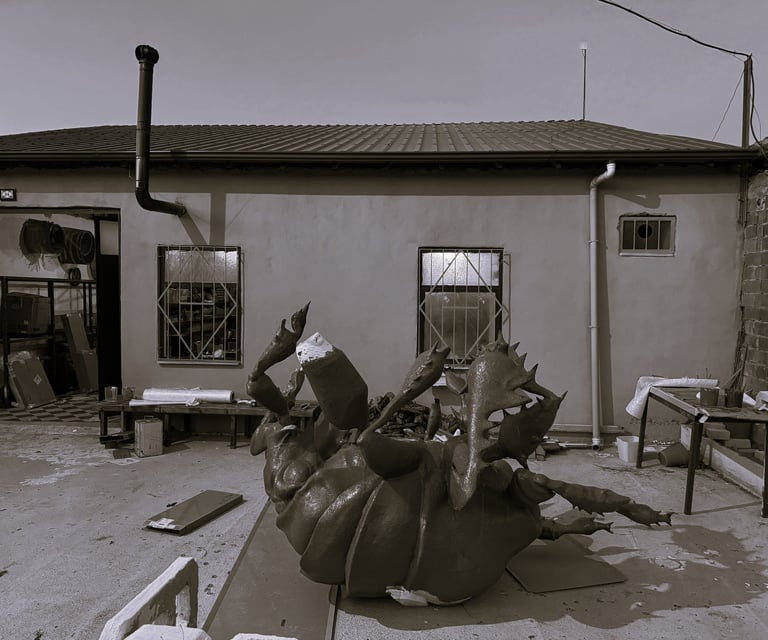
For a long time, sculpture existed as an object to be looked at and to represent. Form was treated as a unified and completed structure. Over time, this understanding gave way to another question: rather than what a work represents, how does it exist? This shift constitutes a defining threshold within my artistic practice. The withdrawal of the result and the emergence of process transform sculpture from a fixed object into something unstable.
I do not work according to predetermined rules during production. Rules become visible only as the work unfolds. For this reason, the process is not approached as a path toward an outcome, but as the act of production itself. Sculpture, in this sense, is not a completed form but a relationship established over time.
This relationship is not independent of the body. For me, sculpture is not merely something to be looked at, but a condition that is thought through the body. The viewer becomes less a detached gaze and more a presence that shares the same space as the work. Distance, proximity, movement, and stillness determine the field of meaning.
Material selection follows this line of thought. Paper, clay, and wooden weaving are not treated as representational tools, but as entities that impose their own limits and resistances. Paper does not symbolize fragility; it carries endurance quietly. Clay renders the weight of decision visible through irreversibility. Wooden weaving, meanwhile, establishes boundaries that exist alongside emptiness, without constructing a closed structure.
For this reason, sculpture is not, for me, the production of an object, but a temporary yet intense encounter between material, body, and space. The process is not a performance to be displayed, but the ethical field of production. Pausing, withdrawing, abandoning, and beginning again are natural components of this field.
Once a work is completed, it leaves the artist’s domain. The outcome is entrusted to the viewer’s experience and interpretation. Meaning begins where control ends. This approach positions sculpture not as a permanent statement, but as a condition that can be reread over time.
I do not see these works solely as productions of the present. I consider them as forms that speak from today yet do not end here — forms situated within the ongoing process of art history. They establish a relationship with the present, while remaining open to being reread in different contexts in the future.
This text is not a declaration of conclusions.
It is a position.
Written from 2025.