AN ESSAY ON THE MEMORY OF THE WILD
Thinking with Women Who Run With the Wolves
Yağmur Çalış
12/22/2025
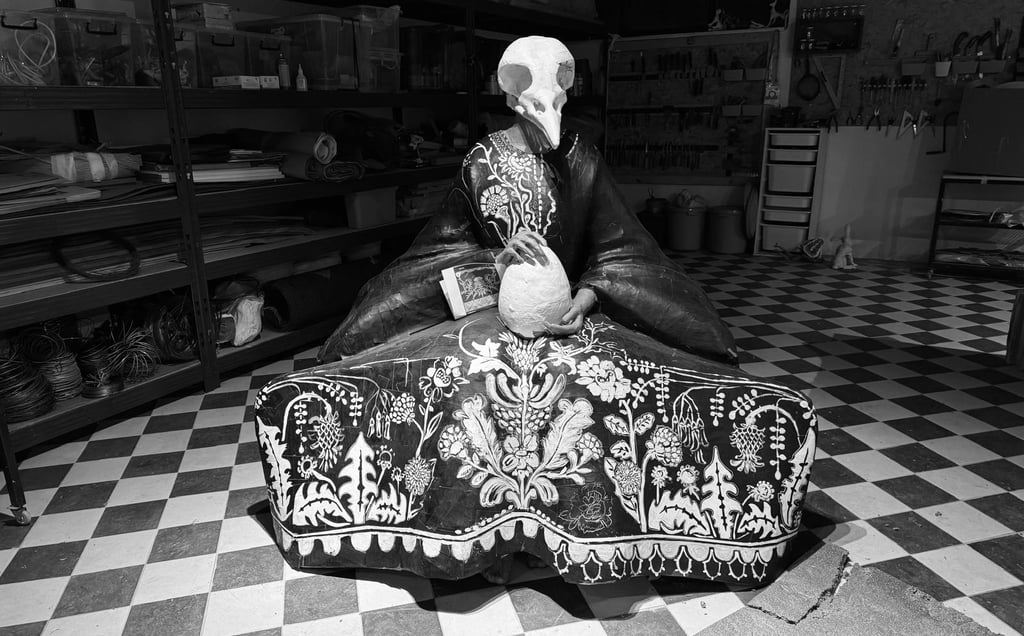
Each time I return to Women Who Run With the Wolves, I sense that the book’s true power does not reside in the stories it tells, but in the spaces it leaves open. Estés never presents a complete or resolved figure of womanhood. Instead, she points toward a being that is repeatedly fragmented, lost, and returned. The wild, in this context, is not a character; it is a form of memory.
This memory does not operate linearly.To remember does not necessarily mean to move forward.
At times it requires withdrawal, dispersion, or silence.
The archetype of the wild woman is not defined by strength, but by a capacity to endure. She is wounded, diminished, yet she does not learn to repair herself—she learns to reassemble. This reconstruction does not emerge from wholeness, but from fractures. Many of the tales are filled with bones, remnants, residues. The body is absent, yet its traces persist.
Here, wildness does not signify chaos or lack of control.On the contrary, it describes an inner order that resists externally imposed notions of completeness.It is not forced to merge, nor does it fear disintegration.
This way of thinking continually leads me back to the same question:How can a body, a form, or an image exist without being whole?
The figures Estés describes are often incomplete.They have lost a part, a limb is missing, a voice has fallen silent.Yet this absence does not weaken them.Instead, it determines their direction.
Perhaps this is why the wild resists completion.To be complete is to be closed.Wild memory, however, remains open.It touches the outside world without sealing itself off.
This perspective draws me away from form as a fixed outcome and toward becoming as a condition.I find myself less concerned with what something looks like,
and more with how it continues to stand.
How it balances what it carries,
what it chooses to protect,
and what it leaves exposed.
The wild is not unprotected.
But its mode of protection does not produce hard shells.
Instead, it establishes flexible boundaries.
There are no absolute lines between what is let in and what is kept out.
For this reason, I do not think of this text as a conclusion,but as a residual beginning.It is not yet a sculpture.Not yet a painting.
But perhaps one day it may become a core—a reminder of why a form does not fully close,
why a part of it remains exposed,
or why different materials can stand side by side
without transforming into one another.
Because some works begin first as a wild thought.And they want to remain that way for a long time.